
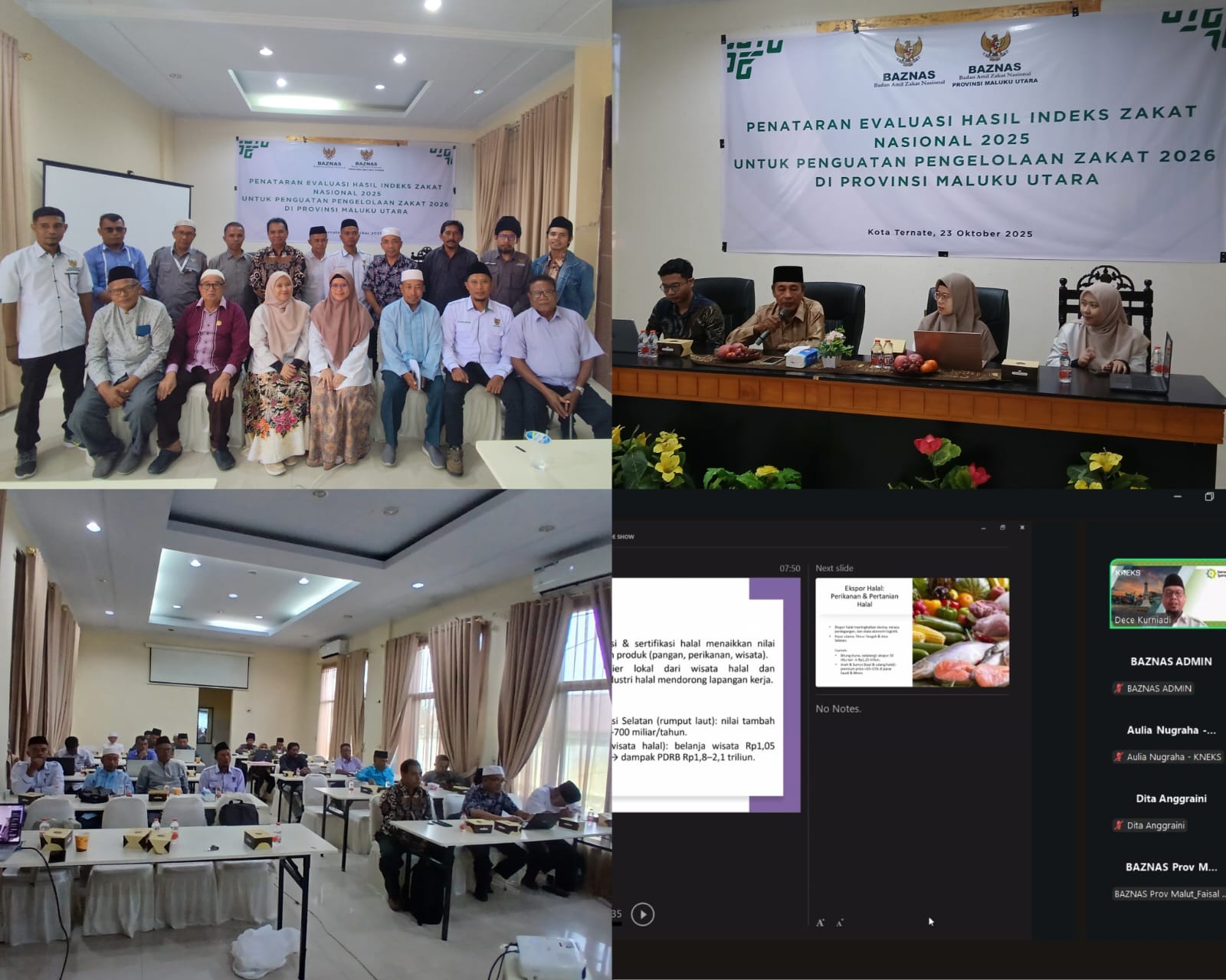
Ternate, October 23, 2025 - The National Board of Zakat (BAZNAS) of the Republic of Indonesia, in collaboration with the Ministry of National Development Planning (Bappenas) and the National Committee for Islamic Economy and Finance (KNEKS), held a Training and Strengthening Program on the National Zakat Index (IZN) in Ternate, North Maluku, on October 23, 2025.
The program aimed to improve the completion rate of the National Zakat Index (IZN) in North Maluku Province and to enhance inter-institutional synergy in promoting the implementation of IZN as a zakat-based development planning instrument at the regional level.
During the session, Aldi Turindra Rachman from Bappenas explained that the IZN has now been recognized as one of the regional development indicators that can be integrated into the Regional Medium-Term Development Plan (RPJMD) through the Regional Development Information System (SIPD).
Meanwhile, Dr. Dece Kurniadi, S.H., M.M. from KNEKS emphasized the importance of collaboration in strengthening the regional Islamic economic and financial ecosystem. The enhancement of Islamic social funds, such as zakat and waqf, serves as one of the main pillars in the Indonesian Islamic Economic Masterplan (MEKSI) and the National Long-Term Development Plan (RPJPN) 2025–2045.
Representing BAZNAS RI, Aisha Putrina Sari presented the concept of IZN version 3.0, which is currently used as a performance measurement tool for zakat management at the national, provincial, and district/city levels. The IZN score for North Maluku Province in 2024 was recorded in the Developing category (0.30) and is targeted to increase to Stable (0.50) by 2029.
The event concluded with a technical training session on IZN and Zakat Impact Assessment (KDZ) using the Sigma-Z application, facilitated by Indah Hurun Hayana from BAZNAS RI, and attended by representatives from the Provincial BAZNAS and all District/City BAZNAS offices across North Maluku.
Through the synergy between BAZNAS, Bappenas, and KNEKS, it is expected that North Maluku will achieve full IZN completion and further strengthen the role of zakat as a key instrument for regional Islamic economic development.